
When I wrote about alignment in my earlier post, I called it the missing focus, the thread that connects action with intention, growth with responsibility, and innovation with purpose. Since then, readers have circled back to a single question: what does alignment really mean?
Is it a philosophy, a system, a state of mind, or something subtler beneath them all? This is my attempt to answer, though not to conclude.
What Alignment Really Is
Alignment is not a doctrine. Before it is a framework, it is a way of seeing. I use two words with care. Coherence is the state in which a part fits the larger whole it belongs to. Alignment is the ongoing practice of moving toward that state.
Other fields offer analogies, not equivalents. Biology has homeostasis, the way a body holds itself steady [1]. Physics has resonance. Ecology has interdependence. Systems science has feedback [2]. Wisdom traditions speak of balance.
When we act, design or build without sensing this rhythm, we generate noise: progress that distorts instead of harmonizing. Alignment is not perfection but coherence, the rhythm by which parts remember the whole and move in tune again and again.
The Seven Layers of Coherence
We live and work across many worlds at once: inner and outer, personal and collective. To navigate them, I use a simple map:
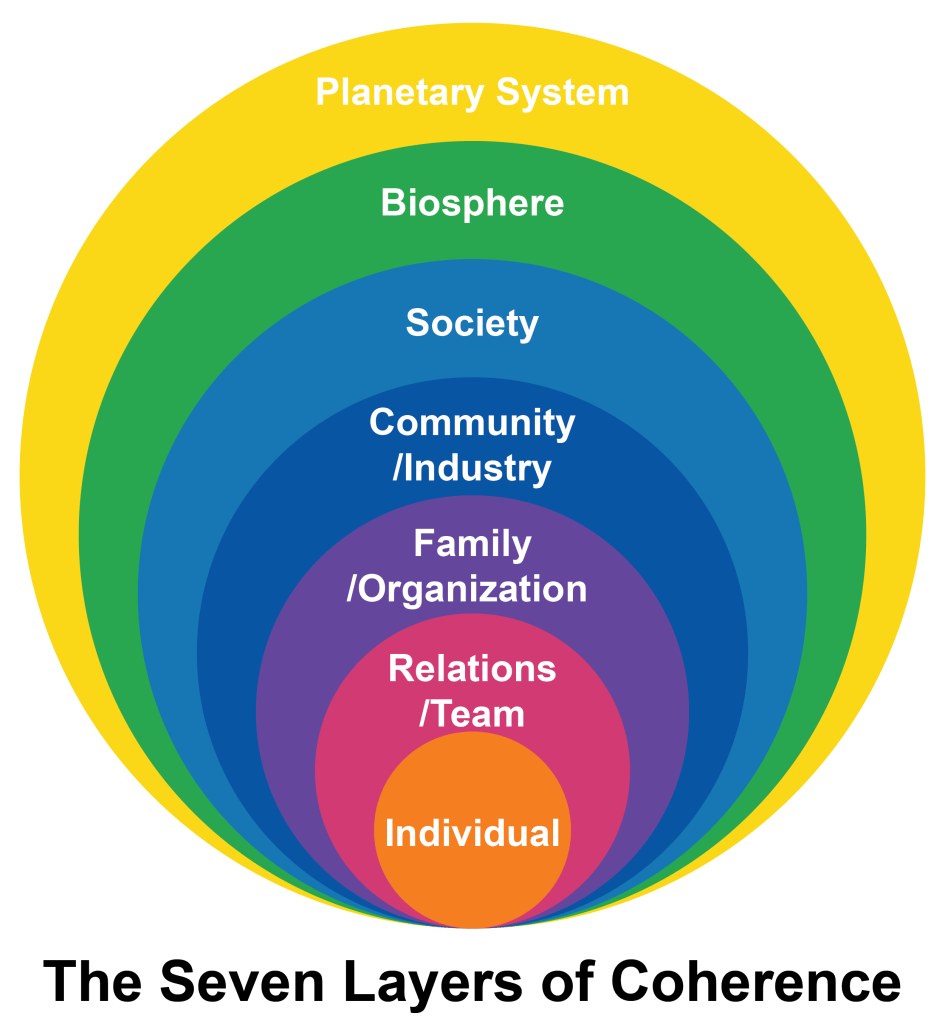
Individual → Relations/Team → Family/Organization → Community/Industry → Society → Biosphere → Planetary System.
The paired labels follow two tracks, the personal (relations, family, community) and the institutional (team, organization, industry). The map builds on earlier nested models of human and living systems [3, 4]. Society here means human collective life at every scale above the community: nations, states and the global institutions that connect them. The biosphere is the whole living world, human and other species, and the web of relationships among them. The planetary system is the outermost layer: Earth as a whole, with its air, oceans, ice, rock and soil and the cycles that connect them [5, 6], together with the Sun and Moon on which its functioning depends and the space beyond Earth that human activity now reaches.
We cannot change the Sun, but coherence at this layer still asks two things of us: to respect the conditions we depend on, and to govern what we now affect [7], from satellites and orbital debris [8] to any attempt to dim sunlight to cool the planet [9].
The nesting is a simplification. Each of us belongs to several teams, organizations and communities at once, and decisions are made in many centres at different scales, not along a single ladder [10]. In practice, these layers overlap more than they stack.
Influence runs both ways. What we do at one level echoes outward, and the outer layers set the conditions for the inner ones. A layer can also be coherent within itself and still be out of tune with those around it; a tightly united group can make badly misjudged decisions [11].
Where layers conflict, two limits hold. The first is ecological: an economy sits within society, and society within the living world, so no inner layer can outgrow what the outer one can bear [12]. The second is human: larger does not mean entitled to override. The dignity and basic needs of each person are a floor, just as the planet’s boundaries are a ceiling [13].
Life unfolds in loops, not lines. A broken feedback, an ignored boundary or an unexamined motive distorts the music of the whole.
A bridge between science and spirit
Alignment is not a new idea. It has been lived and named in many ways, and the traditions are not saying one identical thing.
In Jain thought, right vision, knowledge and conduct together form the path [14]. In Buddhism, the Eightfold Path joins inner awareness with outer action [15]. The Gītā calls yoga “skill in action” [16]. The Qur’an speaks of a balance, set with the raising of the heavens, that people are not to transgress [17]. Christianity describes one body of many parts, and a kingdom within or among us [18]. Taoist texts speak of effortless action, moving with the Way [19]. Many Indigenous traditions, each in its own way, honor reciprocity with what sustains life [20].
Science names feedback. Wisdom speaks of balance. They are not the same claim, but they share an intuition: the part does well when it stays in tune with the whole.
From Fragmentation to Coherence
While doughnut economics, degrowth and wellbeing frameworks invite rethinking [13, 21, 22], most dominant systems still chase growth without asking: growth of what, for whom, and at what cost? The seams are showing in climate breakdown, fractured societies and exhausted hearts.
Alignment is not an endpoint. It is a spectrum, a continual movement from fragmentation toward coherence. Coal powered much of the industrial age, yet it is now deeply misaligned with a stable climate. Solar energy without end-of-life recovery is only partially aligned; cumulative panel waste is projected to reach tens of millions of tonnes by mid-century [23]. A circular, renewable system that regenerates both nature and livelihood moves closer.
No innovation is entirely aligned. The task is to keep retuning.
Consider fashion. A fibre made from agricultural residue seems sustainable until taking it from the field deprives the soil of the organic matter it would have returned [24]. A decarbonization plan may cut emissions yet deepen inequality if workers bear the cost of transition [25]. Alignment reveals such partial harmonies; it teaches humility within innovation.
Creative Destruction Needs a Compass
The 2025 economics prize in memory of Alfred Nobel honoured work on innovation-driven growth, including the theory of creative destruction, the cycle through which new ideas replace old ones [26, 27, 28]. The theory explains how growth happens. The question of direction has been taken up within that same tradition, where it is argued that policy can steer innovation toward cleaner technology [29].
Alignment offers a compass for that steering. Without it, creative destruction risks becoming a treadmill of partial fixes. With it, innovation stays disruptive yet rhythmic.
This is not an argument against growth. Where people still lack food, energy, health care and decent work, growth in incomes remains one of the most reliable routes out of poverty [30], and even advocates of degrowth direct that call at high-income economies, not at those still meeting basic needs [31]. The question is what grows, for whom, and within what limits. Growth that serves coherence across the layers is welcome. Growth that erodes them is not progress.
Growth, then, is a means. Coherence is the goal.
Barriers and Pathways
It is not alignment that falters, but our willingness to follow it. Political cycles prefer the short term, markets chase quarterly returns, departments guard their silos [32]. People, overwhelmed by complexity, revert to habit.
The path forward begins by reweaving what we have separated. In governance, treat alignment as risk reduction and resilience, not moral virtue. In finance, develop investment metrics that assess value across social, ecological and organizational layers. In organizations, use cross-silo scorecards to surface contradictions before they scale. In education and leadership, nurture the capacity to recognize misalignment and respond, not react. And in personal lives, learn to listen for what truly matters.
The Practice of Re-tuning
Alignment does not erase complexity. It helps us navigate it. Friction such as ecological harm, social unrest and personal burnout is feedback as well as failure. Not every signal leaves time to respond; some ecological thresholds, once crossed, may not be reversible on any human timescale [33]. That is the reason to listen early.
It is not an ideology. It is a way of being in the world, at once scientific and spiritual, analytical and intuitive. It is the rhythm beneath systems, and perhaps the compass we have been missing.
Keywords
Alignment, systems thinking, coherence, sustainability, wisdom traditions, creative destruction, fashion, systemic transformation, balance, interdependence
References
- Cannon, W. B. (1932). The Wisdom of the Body. W. W. Norton.
- Meadows, D. H. (2008). Thinking in Systems: A Primer. Chelsea Green Publishing.
- Bronfenbrenner, U. (1979). The Ecology of Human Development: Experiments by Nature and Design. Harvard University Press.
- Miller, J. G. (1978). Living Systems. McGraw-Hill.
- [5] Rockström et al.: https://doi.org/10.1038/461472a (DOI from my own knowledge; the article itself is confirmed)
- Steffen, W., et al. (2015). Planetary boundaries: Guiding human development on a changing planet. Science, 347(6223), 1259855.
- United Nations (1967). Treaty on Principles Governing the Activities of States in the Exploration and Use of Outer Space, including the Moon and Other Celestial Bodies. Adopted by General Assembly resolution 2222 (XXI); opened for signature January 1967.
- Kessler, D. J., & Cour-Palais, B. G. (1978). Collision frequency of artificial satellites: The creation of a debris belt. Journal of Geophysical Research, 83(A6), 2637–2646.
- National Academies of Sciences, Engineering, and Medicine (2021). Reflecting Sunlight: Recommendations for Solar Geoengineering Research and Research Governance. National Academies Press.
- Ostrom, E. (2010). Beyond markets and states: Polycentric governance of complex economic systems. American Economic Review, 100(3), 641–672.
- Janis, I. L. (1972). Victims of Groupthink: A Psychological Study of Foreign-Policy Decisions and Fiascoes. Houghton Mifflin.
- Giddings, B., Hopwood, B., & O’Brien, G. (2002). Environment, economy and society: Fitting them together into sustainable development. Sustainable Development, 10(4), 187–196.
- Raworth, K. (2017). Doughnut Economics: Seven Ways to Think Like a 21st-Century Economist. Random House Business.
- Umāsvāti. Tattvārtha Sūtra 1.1. Trans. N. Tatia (1994), That Which Is: Tattvārtha Sūtra. International Sacred Literature Trust in association with HarperCollins, London.
- Bodhi, Bhikkhu (1984). The Noble Eightfold Path: The Way to the End of Suffering. Buddhist Publication Society, Kandy. See also Saṃyutta Nikāya 45.8 (Magga-vibhaṅga Sutta).
- Bhagavad Gītā 2.50. Trans. Swami Mukundananda, Bhagavad Gita: The Song of God. https://www.holy-bhagavad-gita.org/chapter/2/verse/50 (accessed 10 October 2026).
- Qur’an 55:7–9. Trans. M. A. S. Abdel Haleem. Quran.com. https://quran.com/55/7-9?translations=85 (accessed 10 October 2026).
- The Holy Bible, New International Version (2011). Biblica. 1 Corinthians 12:12–27 (one body, many parts); Luke 17:21 (the kingdom “in your midst”, or “within you”).
- Tao Te Ching, chs. 37 and 48; Slingerland, E. (2003). Effortless Action: Wu-wei as Conceptual Metaphor and Spiritual Ideal in Early China. Oxford University Press.
- Kimmerer, R. W. (2013). Braiding Sweetgrass: Indigenous Wisdom, Scientific Knowledge, and the Teachings of Plants. Milkweed Editions.
- Kallis, G. (2018). Degrowth. Agenda Publishing.
- Stiglitz, J. E., Sen, A., & Fitoussi, J.-P. (2009). Report by the Commission on the Measurement of Economic Performance and Social Progress.
- IRENA & IEA-PVPS (2016). End-of-Life Management: Solar Photovoltaic Panels. International Renewable Energy Agency and International Energy Agency Photovoltaic Power Systems Programme.
- Lal, R. (2005). World crop residues production and implications of its use as a biofuel. Environment International, 31(4), 575–584.
- International Labour Organization (2015). Guidelines for a Just Transition towards Environmentally Sustainable Economies and Societies for All. ILO, Geneva.
- Royal Swedish Academy of Sciences (2025). Press release: The Sveriges Riksbank Prize in Economic Sciences in Memory of Alfred Nobel 2025. 13 October.
- Schumpeter, J. A. (1942). Capitalism, Socialism and Democracy. Harper & Brothers.
- Aghion, P., & Howitt, P. (1992). A model of growth through creative destruction. Econometrica, 60(2), 323–351.
- Acemoglu, D., Aghion, P., Bursztyn, L., & Hemous, D. (2012). The environment and directed technical change. American Economic Review, 102(1), 131–166.
- Dollar, D., & Kraay, A. (2002). Growth is good for the poor. Journal of Economic Growth, 7(3), 195–225.
- Hickel, J. (2021). What does degrowth mean? A few points of clarification. Globalizations, 18(7), 1105–1111.
- Carney, M. (2015). Breaking the tragedy of the horizon: Climate change and financial stability. Speech at Lloyd’s of London, 29 September.
- Lenton, T. M., et al. (2008). Tipping elements in the Earth’s climate system. Proceedings of the National Academy of Sciences, 105(6), 1786–1793.

