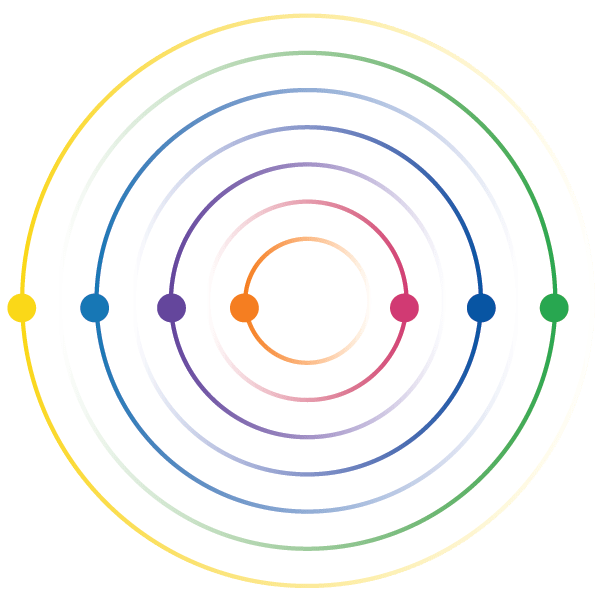
When I wrote about alignment in my earlier post, I called it missing focus, the thread that connects action with intention, growth with responsibility, and innovation with purpose. Since then, conversations and reflections from readers have often circled back to a single question: What does alignment really mean?
Is it a philosophy, a system, a state of mind, or something subtler that sits beneath them all? This is my attempt to answer, though not to conclude.
What Alignment Really Is
Alignment is not a doctrine or a framework. It is a way of seeing, a rhythm through which every system finds coherence with the larger whole it belongs to. Biology calls it homeostasis. Physics calls it resonance. Ecology calls it interdependence. Wisdom calls it balance.
When we act, design, or build without sensing this rhythm, we generate noise, progress that distorts rather than harmonizes. Alignment is not perfection but coherence, the rhythm by which parts remember the whole and move in tune again and again.
The Seven Layers of Coherence
We live and work across many worlds at once: inner and outer, personal and collective, visible and invisible. To navigate them, I use a simple map:
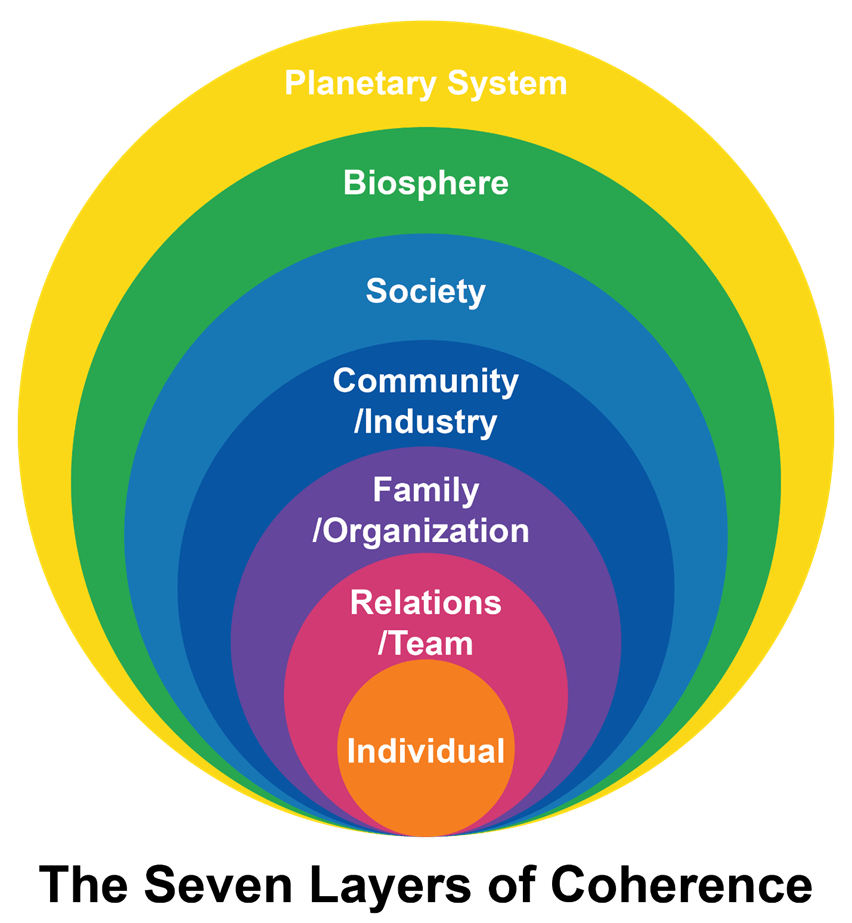
Individual → Relations/Team → Family/Organization → Community/Industry → Society → Biosphere → Planetary System.
Each layer is distinct yet nested. What we do at one level echoes through the rest. When inner intentions drift from outer consequences, misalignment appears in ecosystems, in economies, and in ourselves.
Life unfolds in loops, not lines. Every pulse of an individual heart ripples outward through relationships, families, communities, societies, and the biosphere until it touches the planetary system itself. A broken feedback, an ignored boundary, or an unexamined motive distorts the music of the whole.
A bridge between science and spirit
Across ages and cultures, alignment has never been a new idea. It has been lived and named in countless ways.
In Jain thought, vision, knowledge, and conduct move together. In Buddhism, the Eightfold Path joins inner awareness with outer action. In the Gītā, it is “skill in action,” where duty and awareness become one. Islam speaks of unity and balance, harmony with creation. Christianity describes one body of many parts, and a kingdom both within and among us. Taoist sages call it effortless action, flowing with the Way. Indigenous traditions honor reciprocity, giving back in rhythm with what sustains life.
Science names it feedback. Wisdom calls it balance. Both describe the same principle: coherence between the part and the whole.
From Fragmentation to Coherence
While new models like doughnut economics, degrowth, and wellbeing frameworks invite rethinking, most dominant systems still chase growth without asking: growth of what, for whom, and at what cost? The world we’ve built celebrates speed, novelty, and scale, yet the seams are showing through climate breakdown, fractured societies, and exhausted hearts. Every solution seems to solve and to sever at once.
Alignment is not an endpoint. It is a spectrum, a continual movement from fragmentation toward coherence. Coal is misaligned. Solar energy without end-of-life recovery is only partially aligned. A circular, renewable system that regenerates both nature and livelihood moves closer.
No innovation is entirely aligned. The task is to keep retuning.
Consider fashion. A material recycled out of agricultural waste seems sustainable until it displaces food or interrupts natural cycles of compost and return. A decarbonization plan may reduce emissions yet deepen inequality if workers bear the cost of transition. Alignment reveals such partial harmonies; it teaches humility within innovation.
Creative Destruction Needs a Compass
The recent Nobel Prize in Economics celebrated creative destruction, the cycle through which new ideas replace old ones and drive sustained economic growth. It explains how growth happens, but not toward what end.
Alignment provides that compass. Without it, creative destruction becomes a treadmill of partial fixes, every revolution producing the next crisis. With alignment, innovation remains disruptive yet rhythmic, serving coherence instead of chaos.
Growth, then, is not the goal. Coherence is.
Barriers and Pathways
It is not alignment that falters, but our willingness to follow it. Our systems resist coherence because immediacy feels easier than integrity. Political cycles prefer the short term, markets chase quarterly returns, departments guard their silos. People, overwhelmed by complexity, revert to habit.
The path forward begins by reweaving what we’ve separated. In governance, treat alignment as risk reduction and resilience, not moral virtue. In finance, develop coherence-based investment metrics that evaluate value across social, ecological, and organizational layers.
In organizations, use cross-silo scorecards to surface contradictions before they scale. In education and leadership, nurture the capacity to recognize misalignment and respond, not react. And in personal lives, learn to listen for what truly matters.
Alignment is a practice of attention—noticing what is out of tune and learning how to retune it.
The Practice of Re-tuning
Alignment does not erase complexity. It helps us navigate it. Every crisis is a signal. Friction—ecological harm, social unrest, personal burnout—is not failure but feedback. To live in alignment is to listen to those signals, to sense when the rhythm slips, and to restore it, again and again.
It is not an ideology. It is a way of being in the world, at once, scientific and spiritual, analytical and intuitive. It is the rhythm beneath systems, the heartbeat of coherence, and perhaps the compass we have been missing all along.
Keywords
Alignment, system thinking, coherence, sustainability, wisdom traditions, creative destruction, fashion, systemic transformation, balance, interdependence
 Wizactoscope